Satellite communication in amateur radio opens up a fascinating realm of possibilities for amateur radio operators:
What it is:
- Using space-based repeaters:
- Amateur radio satellites act as repeaters in the sky. They receive signals from ground stations (your radios) and retransmit them back down, allowing for communication over much greater distances than terrestrial repeaters.
- Reaching farther:
- These satellites enable hams to make contacts with other operators across vast regions, even across continents, that would otherwise be impossible with typical ground-based communications.
- Different types of satellites:
- Amateur radio satellites come in various forms, including:
- FM satellites: These are relatively simple to use and are popular for voice communications.
- Linear transponder satellites: These allow for more versatile communications, including single-sideband (SSB) voice and digital modes.
Key Concepts:
- Doppler shift:
- Because satellites are moving at high speeds, the frequency of their signals changes as they approach and recede. This is known as the Doppler effect. Hams need to adjust their radio frequencies to compensate for this.
- Satellite passes:
- Satellites orbit the Earth, so they are only within range for a limited time. These periods of availability are called “satellite passes.”
- Tracking:
- To make successful satellite contacts, hams need to track the satellite’s position and predict its passes. This is often done using specialized software.
- Uplink and downlink:
- “Uplink” is the frequency you transmit on to the satellite.
- “Downlink” is the frequency the satellite transmits back to earth on.
Getting Started:
- Start by researching FM satellites, as they are the easiest to work with.
- Learn about Doppler shift and how to compensate for it.
- Use satellite tracking software to predict passes.
- Begin with simple equipment, such as a handheld transceiver and a directional antenna.
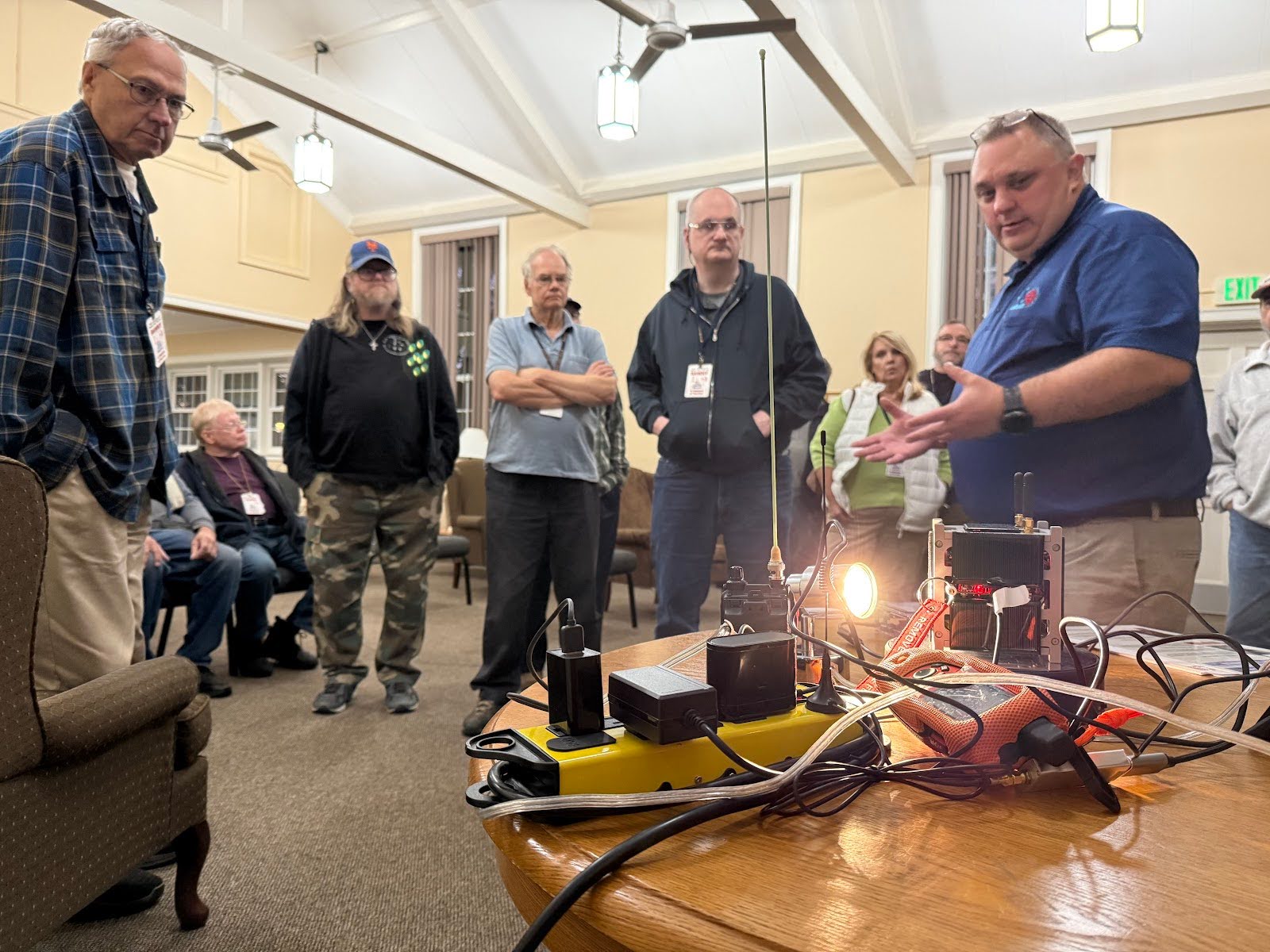
Satellite communication adds a thrilling dimension to amateur radio, allowing you to connect with amateur radio operators around the globe via the vastness of space. We have a lot of members that enjoy and chase satellite communications. Quite a few have even established audio and SSTV communications with the International Space Station. RAWNY has hosted quite a few how-to presentations over the years, just ask and we’ll “beam all we know to you”.